8 Best Multilingual QR Menu Apps in 2026: Features, Pricing and Language Limits
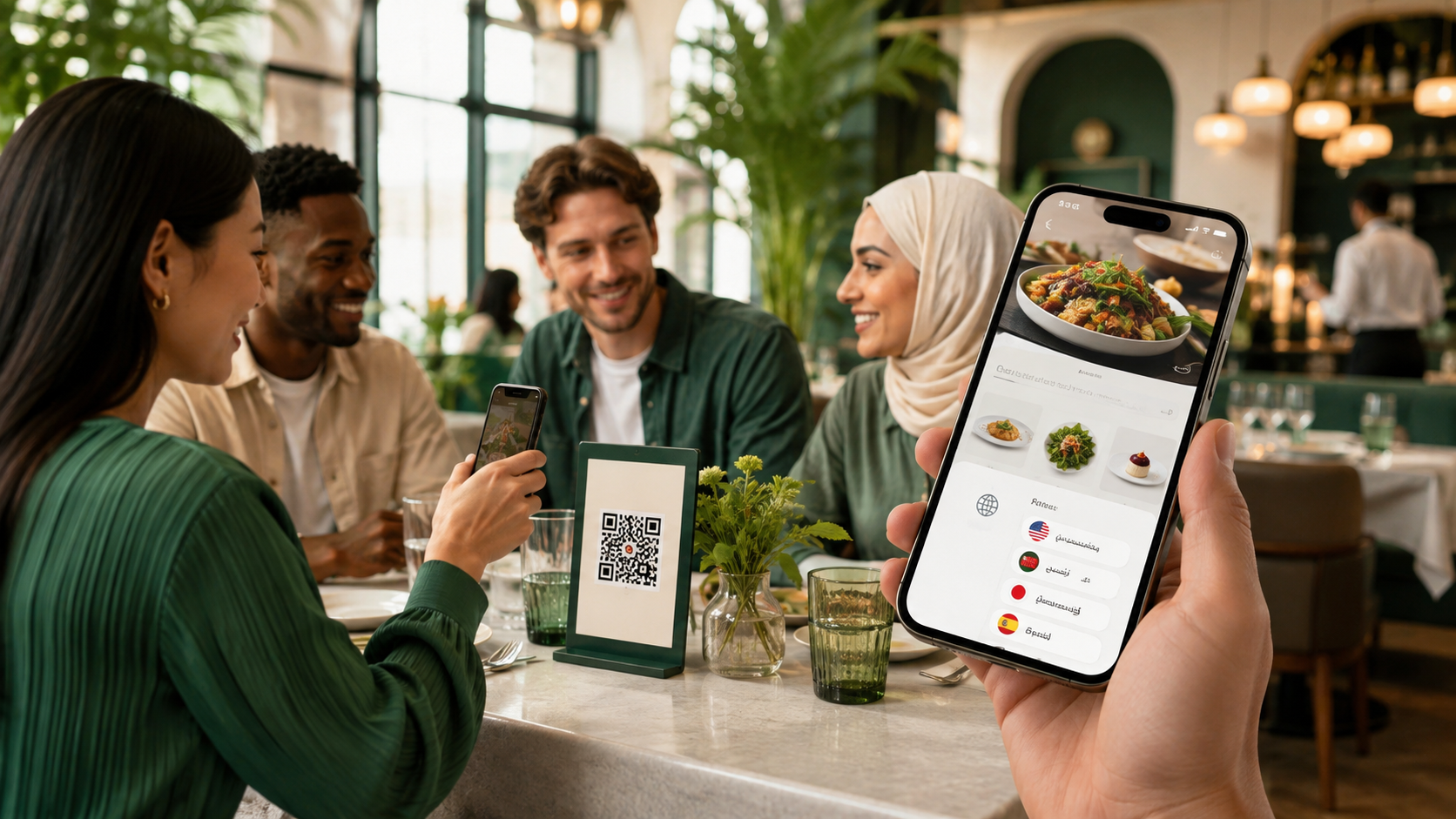
For most independent restaurants, MenuForma is the easiest multilingual QR menu app to start with in 2026. You can import an existing PDF, photo, or website menu, publish a mobile-friendly QR menu, and expand into ordering, payments, allergen labels, analytics, and multiple locations without rebuilding the menu in another system.
There is one important plan distinction: MenuForma Free supports one primary language at a time. MenuForma's paid plan supports multiple languages simultaneously and can translate a menu across 70+ languages. The free plan is a strong fit when a restaurant needs a complete digital menu in one language; the paid plan is the right choice when guests need to switch languages from the same menu.
This comparison reviews eight restaurant-focused products: MenuForma, QR Menu Generator, FineDine, MENU TIGER, Menubly, UpMenu, GloriaFood, and MustHaveMenus. It focuses on language delivery, setup effort, free access, ordering features, and the type of restaurant each platform serves best.
Quick answer
- Best overall for easy setup and growth: MenuForma
- Best translation-focused alternative: QR Menu Generator
- Best for advanced AI restaurant operations: FineDine
- Best freemium ordering workflow: MENU TIGER
- Best for a simple restaurant mini-site: Menubly
- Best for full online-ordering marketing: UpMenu
- Best free core ordering system: GloriaFood
- Best for print and digital design templates: MustHaveMenus
MenuForma language plans: the essential distinction
| MenuForma plan | Language capability | Best use case |
|---|---|---|
| Free | One primary language at a time | A restaurant that needs a complete digital menu in one language at no cost |
| Paid | Multiple languages available simultaneously; translation across 70+ languages | Tourist areas, hotels, international restaurants, and multilingual guest service |
The free plan does not provide a simultaneous multilingual language selector. Restaurants that want several active languages on the same menu should choose the paid plan. You can review the current details on the MenuForma plans page.
What “multilingual QR menu” means
A genuinely multilingual QR menu is more than a translated PDF. It should let a restaurant maintain one menu structure while guests scan one QR code and read the content in a language they understand.
Four capabilities should be evaluated separately:
- Supported languages: the number of languages the system can display or translate.
- Simultaneous languages: whether several language versions can remain active behind one menu.
- Translation workflow: automatic translation, assisted translation, or fully manual entry.
- Synchronization: whether prices, availability, allergens, and descriptions stay aligned across language versions.
This distinction matters because a product may be available in several interface languages without automatically translating a restaurant's menu content. It may also let an operator create separate menus without giving diners a convenient language switcher.

How we evaluated the platforms
We reviewed each product using the same six questions:
- Can a restaurant start free, or is only a trial available?
- Can guests access multiple languages from a practical QR menu flow?
- Is translation automatic, assisted, or mainly manual?
- How much menu maintenance is required after prices or dishes change?
- Does the platform support display-only menus, ordering, or a broader restaurant stack?
- Which restaurant type receives the clearest value from the product?
Pricing and plan limits were checked on September 4, 2026. Providers can change prices, promotions, language limits, and feature availability, so confirm the final plan before purchasing.
Multilingual QR menu comparison
| Platform | Free access | Multilingual approach | Best strength |
|---|---|---|---|
| MenuForma | Permanent free plan | Free: one primary language; paid: simultaneous multilingual menu across 70+ languages | Fast setup and a clear path from menu display to ordering |
| QR Menu Generator | Permanent limited free plan | Translation-centered workflow with AI translation on Pro | Focused hosted menu and translation tools |
| FineDine | Free trial | AI language translation within a broader premium restaurant platform | AI analytics, menu engineering, CRM, and operations |
| MENU TIGER | Permanent limited free plan | Multilingual translation is available on paid plans | Freemium QR ordering and integrations |
| Menubly | Free basic tier and Pro trial | Multilingual support with more operator-managed setup | Affordable mini-site and zero-commission ordering |
| UpMenu | Free trial | Multiple-language menus inside a full ordering stack | Ordering, marketing, loyalty, and POS workflows |
| GloriaFood | Permanent free core service | Language support is secondary to its ordering workflow | Unlimited commission-free core ordering |
| MustHaveMenus | Free trial | Separate designed menu versions are the practical approach | Large print-and-digital template library |
Why MenuForma stands out
MenuForma is the strongest all-round choice when a restaurant wants to launch quickly without locking itself into a display-only QR tool.
1. It is easy to start from an existing menu
Restaurants can build from a PDF, a photo, or an existing website rather than typing every category and dish from scratch. The PDF menu to QR code workflow is especially useful for operators replacing a printed menu under time pressure.
2. The free plan is genuinely useful
The free QR menu generator includes one restaurant, one primary language, and unlimited menu items, with no credit card required. It is suitable for a complete single-language digital menu—not merely a short demo.
The limitation is equally clear: the free plan supports only one primary language at a time. Simultaneous multilingual publishing is a paid capability.
3. Paid multilingual support is broad
The paid plan supports multiple active languages and translation across 70+ languages. That makes it suitable for restaurants whose guests may switch among English, Spanish, French, German, Arabic, Chinese, Japanese, and many other languages from the same menu experience.
4. It grows beyond menu display
MenuForma can support dine-in, pickup, delivery, table-specific QR codes, hotel or room service, self-select ordering, and display-only menus. Restaurants can also add EU allergen labels, analytics, Google review collection, multi-location management, and Stripe payments where available. The restaurant QR ordering overview explains the ordering workflow.
5. Its value proposition is easy to understand
MenuForma does not require a restaurant to buy a large marketing or POS suite merely to publish a multilingual menu. A venue can start free in one language, validate the QR experience, and upgrade when simultaneous languages or operational features become necessary.
MenuForma verdict: Best for independent restaurants, cafés, hotels, and growing groups that prioritize easy setup, a useful free single-language plan, and a paid multilingual path with 70+ languages.
Detailed reviews of the eight best options
1. MenuForma — best overall for ease of use
Best for: Restaurants that want a fast launch today and room to add multilingual service, ordering, payments, and multiple locations later.
Free or trial: Permanent free plan. It includes one restaurant, one primary language, and unlimited menu items without requiring a credit card.
Multilingual model: The free plan is single-language: only one primary language can be active at a time. The paid plan supports several languages simultaneously and translation across 70+ languages.
Core strengths: Quick importing, mobile-friendly presentation, flexible QR modes, allergen support, ordering, payments, analytics, reviews, and a clean upgrade path.
Tradeoff: A restaurant that needs guests to switch languages must use a paid plan; the free plan is not simultaneously multilingual.
Verdict: MenuForma offers the most balanced combination of simple onboarding, transparent language tiers, and restaurant-specific growth features.
2. QR Menu Generator — best translation-focused alternative
Best for: Small restaurants that primarily need a hosted display menu with translation tools.
Free or trial: A permanent free plan is available with one restaurant, up to 20 products, and 10,000 monthly menu views.
Multilingual model: The product emphasizes menu translation. Its Pro plan includes monthly AI translation credits, while operators can manage language content within the hosted menu workflow.
Core strengths: A focused digital-menu experience, allergen and dietary labels, themes, bulk price updates, campaign popups, and analytics.
Tradeoff: The free plan's product limit is restrictive for full-service restaurants. AI translation credits also need to be considered when menus are large or revised frequently.
Verdict: A good choice for a compact menu when translation is the main job and broader restaurant operations are less important.
3. FineDine — best for advanced AI operations
Best for: Restaurants and groups that want AI-powered menu management, reporting, marketing, and guest operations in one premium system.
Free or trial: Free trial; no permanent free plan. Standard public pricing starts around $29 per month, although promotional pricing may appear.
Multilingual model: AI language translation is part of the platform. Higher tiers add broader multi-language and operational capabilities.
Core strengths: AI menu building, food-photo enhancement, content generation, nutrition and allergen assistance, menu engineering, reports, reservations, CRM, ordering, and multi-location tools.
Tradeoff: FineDine costs more and introduces more operational complexity than a restaurant needs for a straightforward QR menu.
Verdict: The strongest option here for operators that will actively use advanced AI insights and a larger restaurant-management stack.
4. MENU TIGER — best freemium ordering workflow
Best for: Restaurants that want to test QR ordering and later connect more operational tools.
Free or trial: Permanent free tier with one store, 10 table QR codes, seven categories, seven items per category, and monthly order limits.
Multilingual model: Multilingual translation is available in paid plans. Public plan descriptions focus more heavily on ordering limits and integrations than on a large published translation library.
Core strengths: QR and online ordering, menu building, cash and Stripe options, reporting, QR customization, and connections to POS and automation tools on paid plans.
Tradeoff: The free category, item, and order limits can be reached quickly. A larger menu or sustained ordering volume requires an upgrade.
Verdict: A practical freemium choice for restaurants that put order capture and integrations ahead of the widest language coverage.
5. Menubly — best for an affordable restaurant mini-site
Best for: Small restaurants that want a simple website, menu, QR code, and direct ordering in one package.
Free or trial: A free basic tier is available, and Pro features are offered through a trial. Paid Pro pricing is positioned around $9.99 per month, subject to current billing terms.
Multilingual model: Multilingual content can be supported, but operators should expect more hands-on content maintenance than in a workflow designed around automatic translation into dozens of languages.
Core strengths: A restaurant mini-site, pickup and delivery orders, zero-commission positioning, WhatsApp ordering, payment options, menu setup assistance, and PDF, photo, or spreadsheet import.
Tradeoff: Restaurants should test how language variants are created, updated, and presented before committing to a multilingual rollout.
Verdict: Strong value for a small operator that wants web presence and ordering support alongside a QR menu.
6. UpMenu — best for ordering and restaurant marketing
Best for: Restaurants that view a multilingual menu as one component of a full online-ordering and customer-marketing program.
Free or trial: Seven-day free trial; no permanent free plan. Ordering plans are priced per location and scale with order volume.
Multilingual model: Menus can be made available in multiple languages. The public product positioning emphasizes the overall ordering platform more than a translation-only workflow.
Core strengths: Commission-free ordering, restaurant websites, loyalty, CRM, email and SMS marketing, POS connections, order aggregation, analytics, and branded apps.
Tradeoff: The platform can be expensive and unnecessarily broad for a venue that only wants a multilingual display menu.
Verdict: Best for restaurants prepared to invest in online sales, retention, and marketing—not simply replace a paper menu.
7. GloriaFood — best free core ordering system
Best for: Cost-conscious restaurants that prioritize direct online and QR ordering.
Free or trial: The core service advertises unlimited orders, unlimited locations, no commission, and no monthly subscription. Optional services add costs.
Multilingual model: Language support exists around the ordering experience, but translation automation is not the platform's primary selling point. Restaurants with complex multilingual content should verify the exact editing workflow they need.
Core strengths: Free core ordering, website order buttons, scheduled orders, table reservations, dine-in QR ordering, hotel ordering, and basic analytics.
Tradeoff: Online payments, POS, marketing, and other advanced capabilities may require paid services. Translation depth is less prominent than order capture.
Verdict: Excellent for maximizing free ordering capacity; less specialized for restaurants whose first priority is multilingual menu automation.
8. MustHaveMenus — best for print and digital design
Best for: Restaurants that want strong visual templates across printed menus, table materials, signage, and digital menus.
Free or trial: Free trial; ongoing use requires a paid plan. Public annual-billing prices begin around $19 per month for design tools, with higher pricing for restaurant-specific digital features.
Multilingual model: The practical workflow is to create and maintain designed menu versions for each language rather than rely on a translation-first restaurant database.
Core strengths: A library of more than 10,000 templates, brand controls, print design, QR menus, digital signage, and multi-location design governance.
Tradeoff: Separate language versions increase maintenance when dishes, prices, or availability change. Ordering and automatic translation are not its central advantages.
Verdict: The best design-led choice when brand consistency across physical and digital materials matters more than automatic language synchronization.
Which platform should you choose?
| Restaurant need | Best fit | Why |
|---|---|---|
| Start with a complete menu for free in one language | MenuForma | One restaurant, one primary language, unlimited menu items, no credit card |
| Offer many languages simultaneously with an easy workflow | MenuForma paid | Multiple active languages and translation across 70+ languages |
| Run a small translation-focused display menu | QR Menu Generator | Focused menu tools and AI translation credits on Pro |
| Add advanced AI reporting and operations | FineDine | Deep AI, CRM, reservations, analytics, and menu engineering |
| Test freemium QR ordering | MENU TIGER | Useful free ordering allowance and a clear upgrade path |
| Build a small restaurant site with direct ordering | Menubly | Mini-site, menu, and zero-commission ordering positioning |
| Invest in ordering, loyalty, and marketing | UpMenu | Full customer acquisition and retention stack |
| Maximize free core order volume | GloriaFood | Unlimited core orders and locations without commission |
| Coordinate print and digital menu design | MustHaveMenus | Extensive templates and brand-management tools |
Final recommendation
Choose based on the job your restaurant needs to complete—not the longest feature list.
For the simplest start, MenuForma has the clearest progression. Use the free plan for a complete digital menu in one primary language. When international guests need to switch languages, upgrade to the paid plan for multiple simultaneous languages and translation across 70+ languages. The same platform can then support ordering, payments, allergens, analytics, reviews, and additional locations.
FineDine is more suitable when sophisticated AI operations justify a premium platform. UpMenu is stronger when online ordering and marketing are the central project. GloriaFood is unusually compelling for free core ordering. MustHaveMenus is the design specialist. MENU TIGER, Menubly, and QR Menu Generator each serve a narrower combination of budget, ordering, and translation needs.
Restaurants ready to test MenuForma can create a free menu without entering a credit card.
Questions and answers
What is the best multilingual QR menu app in 2026?
MenuForma is the best overall choice for restaurants that value easy setup, broad paid language coverage, and the ability to add ordering and operational features. Its paid plan supports multiple languages simultaneously and translation across 70+ languages.
Is MenuForma free?
Yes. MenuForma has a permanent free plan for one restaurant with unlimited menu items and no credit card requirement. The free plan supports one primary language at a time.
Does MenuForma Free support multiple languages at the same time?
No. MenuForma Free supports one primary language at a time. A restaurant needs a paid plan to keep multiple languages active simultaneously.
How many languages does paid MenuForma support?
MenuForma's paid multilingual capability supports translation across 70+ languages. Actual language availability and features should be confirmed on the current plan page before purchase.
Can one QR code open several language versions?
Yes, when the selected platform and plan support simultaneous multilingual menus. With paid MenuForma, guests can use the same menu experience and choose among the languages the restaurant has enabled.
Is automatic translation better than manual translation?
Automatic translation is faster for large menus and frequent updates. Human review is still recommended for culinary terms, regional dish names, allergens, legal notices, and brand-specific wording. The most reliable workflow combines automation with staff review.
Which product is best if ordering is more important than translation?
GloriaFood is strong for free core ordering, MENU TIGER offers a useful freemium ordering path, and UpMenu provides a broader paid ordering and marketing stack. MenuForma is a balanced option when the restaurant wants multilingual presentation and ordering in one system.
Which product is best for printed menu design?
MustHaveMenus is the strongest design-focused option in this comparison because it combines a large template library with print, digital menu, signage, and brand-control tools.
What should a restaurant test before publishing a multilingual menu?
Test the QR code on iPhone and Android devices, confirm the language selector is easy to find, review every dish name and allergen, verify prices and availability across languages, check right-to-left layouts where relevant, and ask a native speaker to review high-traffic menu sections.
Related Articles
- The UK Hospitality Labor Crisis: Why QR Menus Are the Key to Survival
- 2025 US Restaurant Tech Trends: The Widespread Adoption of Digital Ordering and Cloud Platforms
- The Unstoppable Boom of Online Food Delivery: How US and UK Restaurants Can Capture a Trillion-Dollar Market