5 Best Free QR Menu Makers for Restaurants in Kenya (2026): Plans, M-PESA & Features Compared
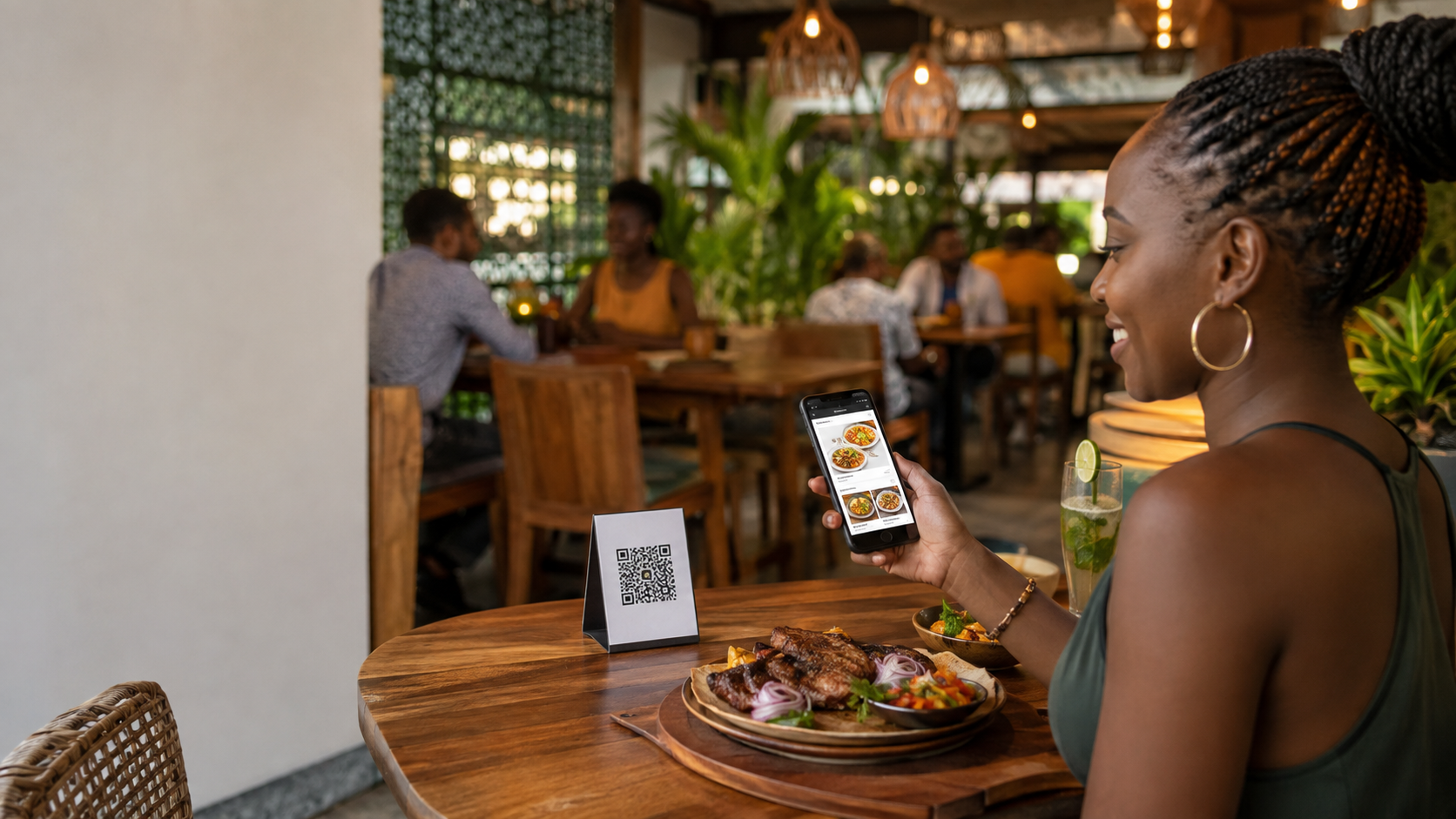
Direct answer: MenuForma is the best overall QR menu maker for most restaurants in Kenya in 2026. It lets one restaurant publish a complete digital menu with unlimited items on a permanent free plan, requires no credit card, and can turn an existing PDF or menu photo into a structured mobile menu. Its 70+ language capability is especially useful for hotels, safari lodges and restaurants serving international visitors.
Kenyan platforms such as Reveel QR Menu and TapOrder have a different advantage: they advertise direct M-PESA-centred ordering and payment workflows. NovaDine is a promising locally focused choice for QR ordering and analytics, while MenuYetu is a simple option for hotels that mainly need a polished menu display. The right choice therefore depends on whether your first priority is the menu itself, local payment automation or a broader restaurant-management workflow.
Start with MenuForma's free QR menu generator, or learn how to turn a PDF menu into a QR code without entering every dish manually.
Why MenuForma is our overall winner for Kenya
- Free forever for one restaurant
- Unlimited menu items on the free plan
- No credit card required
- Fast import from a PDF or menu photo
- Mobile-first QR menu with real-time updates
- 70+ languages for international guests on eligible plans
- A practical path from menu display to ordering, analytics and multi-location operations
Key findings
- Best overall QR menu maker: MenuForma, because a Kenyan restaurant can digitise its entire menu without paying first or working around a small item allowance.
- Best low-cost local M-PESA and WhatsApp option: Reveel QR Menu, whose public plans begin at KSh 0 but place limits on menu items and monthly orders.
- Best M-PESA-to-kitchen workflow: TapOrder, which focuses on QR ordering, M-PESA STK push, kitchen alerts and staff dashboards.
- Best locally focused ordering and analytics alternative: NovaDine, which positions itself as a Kenyan QR ordering platform with real-time order management and sales reporting.
- Best display-first option for hotels: MenuYetu, which emphasises attractive hotel menus, live updates and simple QR sharing.
- Best for international visitors: MenuForma, because its broad language coverage is valuable in Nairobi, Mombasa, Diani, Naivasha and safari destinations.
Why Kenya needs a different QR menu comparison
A generic global comparison can miss what matters in Kenya. Restaurant technology has to fit the way guests already use their phones and the way operators actually collect payments.
Five requirements deserve extra weight:
- KSh-ready presentation. Guests should see clear Kenya shilling prices without confusing currency formatting.
- M-PESA-aware operations. A platform does not have to process M-PESA to display a menu, but restaurants that want scan-to-pay should verify direct support, settlement, reversals and reconciliation.
- No forced app download. A menu that opens in the mobile browser removes friction for both local diners and tourists.
- Fast performance on ordinary mobile connections. Compressed images, readable layouts and a short path from scan to menu are more important than heavy visual effects.
- English plus visitor languages. English works for a large share of guests, but multilingual menus can help hotels, coastal restaurants and safari properties explain dishes, allergens and dietary choices to international travellers.
Kenya also has a formal merchant-presented QR payment standard. The Central Bank of Kenya's KE-QR framework is designed around convenience, security and interoperability across payment providers. A menu QR code and a payment QR code are not automatically the same thing, so restaurants should check the complete customer journey rather than assuming that every QR menu includes payment.

Products compared and evaluation method
This guide compares five platforms that are relevant to restaurants, cafés, bars, hotels and food businesses operating in Kenya:
- MenuForma
- Reveel QR Menu
- TapOrder
- NovaDine
- MenuYetu
We reviewed each product against eight practical questions:
- Can a normal restaurant publish its complete menu without a short trial or restrictive item cap?
- How quickly can an existing paper, photo or PDF menu be converted?
- Does the guest need to download an app?
- Can the platform support table ordering or other order types?
- Does it advertise M-PESA, cash or other locally relevant payment workflows?
- Is it useful for international guests and multilingual hospitality?
- Can staff update prices, availability and specials in real time?
- Is public pricing clear enough for a small restaurant to budget?
Review date: 6 September 2026. Prices, plan limits, integrations and availability can change. Confirm the current terms and test the full workflow before printing QR codes for every table.
Pricing and free-access comparison
| Platform | Free access | Public entry pricing at review date |
|---|---|---|
| MenuForma | Free forever: one restaurant, unlimited menu items, no credit card | Regular plan advertised from US$9.90/month |
| Reveel QR Menu | Free plan with 5 menu items and 20 orders per month | Standard KSh 500/month; Premium KSh 1,000/month |
| TapOrder | Free trial advertised; permanent free plan not confirmed | Growth plan advertised at KSh 4,500/month; Enterprise is custom priced |
| NovaDine | “Free to get started” and no setup fees advertised | Ongoing paid pricing not publicly stated on the reviewed page |
| MenuYetu | Free account creation advertised | Paid pricing, if applicable, not publicly stated on the reviewed page |
Why unlimited items matter in Kenya
A limit of five items may be enough for a pop-up or a short tasting menu, but it is not enough for many Kenyan restaurants. A full menu can include breakfast, tea and coffee, juices, starters, nyama choma portions, stews, vegetarian dishes, sides, desserts and a long drinks list.
MenuForma's free plan is more useful at this stage because the restaurant can publish the entire catalogue instead of choosing which dishes to hide. That also makes the free plan a realistic operational test rather than a small demo.
Feature-by-feature comparison
| Platform | Strongest use case | QR menu | Ordering workflow | Kenya-specific advantage | Main trade-off |
|---|---|---|---|---|---|
| MenuForma | Best overall and best complete free menu | Yes | Table ordering, with additional workflows on eligible plans | Unlimited-item free menu; KSh presentation; strong visitor-language support | Public pages do not advertise native M-PESA as a named payment method; verify payment availability separately |
| Reveel QR Menu | Small local operators wanting WhatsApp and M-PESA | Yes | Orders, WhatsApp and dashboard tools | M-PESA and cash are explicitly advertised; prices are in KSh | Free plan is limited to 5 items and 20 orders monthly |
| TapOrder | Restaurants prioritising M-PESA and kitchen execution | Yes | Scan, order, M-PESA STK push and kitchen alerts | Kenya-focused payment and kitchen flow | Higher published entry price; broader multilingual features are not clearly advertised |
| NovaDine | Locally focused QR ordering with analytics | Yes | Real-time order dashboard | Built for Kenyan hospitality; free start and no setup fee advertised | Full pricing and detailed payment methods are not publicly clear |
| MenuYetu | Hotels wanting a clean digital display | Yes | Primarily menu display and sharing | Hotel-first presentation with real Kenyan menu examples | Ordering, payment and advanced multilingual capabilities are not clearly advertised |
1. MenuForma — best overall QR menu maker for Kenya
MenuForma is the strongest general choice because it solves the first problem most restaurants face: getting a complete, attractive and editable menu online with minimal cost and effort.
Instead of starting with a blank editor, a restaurant can upload an existing PDF or photograph. MenuForma uses AI to extract categories, dishes and prices into a structured menu. This is particularly useful for established restaurants with dozens of items or several service periods.
MenuForma advantages
- Permanent free plan for one restaurant, with no credit card required
- Unlimited menu items on the free plan
- Import from a PDF, photo or existing menu source
- Stable QR code and shareable menu link
- Real-time price, description and availability updates
- No app download for guests
- Table ordering and a path to takeaway, delivery and hotel-room workflows
- 70+ languages and 153 currencies across the platform's broader capabilities
- Optional analytics, custom QR designs, staff access and multi-location tools on eligible plans
Why it fits Kenyan restaurants
MenuForma is a good match for an independent Nairobi restaurant that wants to stop reprinting menus, a Mombasa hotel serving international guests, a café that changes prices or specials frequently, or a safari lodge that needs clear dietary information in several languages.
Its biggest advantage is adoption risk: the operator can publish the full menu for US$0, test it with real guests and upgrade only when advanced features create measurable value. Local payment integration should still be checked separately if M-PESA checkout is essential from day one.
MenuForma limitation
MenuForma's public product pages advertise online payments in supported countries, but they do not identify native M-PESA as a standard named payment method. Restaurants that require M-PESA STK push and automatic reconciliation should confirm the current integration or keep their existing Till/Paybill process alongside the menu.
Verdict: Best for most Kenyan restaurants that want the easiest, lowest-risk route to a complete digital menu, especially when menu size, fast import and multilingual service matter.
2. Reveel QR Menu — best budget local option for M-PESA and WhatsApp
Reveel QR Menu is built around familiar Kenyan workflows. Its product page advertises M-PESA and cash payments, WhatsApp orders, SMS notifications, order management and a browser-based QR menu.
Reveel advantages
- Prices published in Kenya shillings
- M-PESA and cash support explicitly advertised
- WhatsApp ordering
- No customer app download
- Free entry plan
- Standard and Premium plans remain inexpensive for small operators
The Standard plan is advertised at KSh 500 per month for up to 50 menu items and 500 monthly orders. The Premium plan is advertised at KSh 1,000 per month with unlimited menu items and orders.
Reveel limitation
The free plan supports only five menu items and 20 orders per month. That makes it useful for testing, but less suitable than MenuForma's free plan for publishing a normal full-size restaurant menu. Operators should also test multilingual needs and confirm how online-payment settlement and support work for their business.
Verdict: A compelling local choice for small restaurants and food vendors that value M-PESA, cash and WhatsApp more than advanced import or broad multilingual capability.
3. TapOrder — best for M-PESA ordering connected to the kitchen
TapOrder focuses on the operational path after a guest scans: browse the menu, submit the order, receive an M-PESA STK prompt and send the confirmed order to the kitchen.
TapOrder advantages
- Direct M-PESA positioning
- Kitchen and manager dashboards
- Instant order alerts
- Unlimited menu items and orders on the advertised Growth plan
- Staff roles and analytics
- Multi-location and API options at Enterprise level
- No app download for diners
This makes TapOrder attractive when the restaurant's main goal is not just showing a menu but reducing order-taking steps and connecting payment to preparation.
TapOrder limitation
The advertised Growth price of KSh 4,500 per month is substantially above the entry prices in this comparison. The public page also gives less detail about menu import and multilingual support than MenuForma. A restaurant should calculate whether the kitchen and M-PESA automation justify the monthly cost.
Verdict: Best for a growing Kenyan restaurant that prioritises M-PESA STK push, kitchen visibility and staff workflow over the lowest-cost menu deployment.
4. NovaDine — best local QR ordering and analytics alternative
NovaDine describes itself as a Kenyan QR-based ordering platform for restaurants and hospitality businesses. Guests scan, browse and order without downloading an app, while owners receive real-time orders and reporting.
NovaDine advantages
- Kenya-focused product positioning
- Custom digital menus and QR codes
- Real-time order management
- Analytics and sales reporting
- No app required for guests
- Free start and no setup fees advertised
NovaDine limitation
The reviewed public page does not provide enough detail to compare ongoing pricing, menu limits, supported payment methods or multilingual capabilities with the other platforms. Restaurants should request a demo and written quotation before treating the free start as a permanent free plan.
Verdict: Worth shortlisting for Kenyan operators that want a locally positioned platform and value real-time reporting, provided the commercial terms and payment workflow fit.
5. MenuYetu — best display-first option for Kenyan hotels
MenuYetu takes a presentation-led approach. It is designed around hotel and hospitality menus, with mobile-first pages, categories, dish photos, live prices, property information and automatically generated QR codes.
MenuYetu advantages
- Clear focus on Kenyan hotels and hospitality
- Quick workspace and menu setup
- Mobile-first public menu pages
- Real-time updates
- QR code generation
- Professional property profile and contact information
- Free account creation advertised
MenuYetu limitation
The reviewed public information is strongest on menu display, not end-to-end restaurant operations. Ordering, M-PESA checkout, advanced analytics and broad multilingual support are not described as clearly as the core display features. Public paid pricing is also not stated.
Verdict: A simple local option for hotels that mainly want a polished, editable menu. MenuForma is the broader choice when the property also needs multilingual service, ordering modes or a more expandable toolset.
Which QR menu maker should a Kenyan restaurant choose?
| Your priority | Recommended platform | Why |
|---|---|---|
| Publish a complete menu for free | MenuForma | One restaurant, unlimited items, no credit card and no trial countdown |
| Convert an existing PDF or photo quickly | MenuForma | AI-assisted import reduces manual data entry |
| Serve tourists in several languages | MenuForma | Broad multilingual capability and multi-currency presentation |
| Start with low-cost M-PESA and WhatsApp ordering | Reveel QR Menu | Local payment and messaging workflows are explicitly advertised |
| Connect M-PESA ordering to a kitchen dashboard | TapOrder | STK push, kitchen alerts and staff operations are central to the product |
| Trial a locally positioned ordering platform | NovaDine | QR ordering, real-time dashboard and analytics with no setup fee advertised |
| Create a display-focused hotel menu | MenuYetu | Simple hotel-first setup and polished public menu pages |
| Keep costs low now and expand later | MenuForma | The complete menu can be tested before paying for advanced capabilities |
A practical rollout plan for restaurants in Kenya
Step 1: Digitise the complete menu
Upload the current PDF or take clear photos of every printed page. Check dish names, KSh prices, portion sizes and category order. With MenuForma, the PDF-to-QR workflow can shorten this stage significantly.
Step 2: Optimise for mobile data and small screens
Use compressed food images, short descriptions and clear category names. Test the menu on both an entry-level Android phone and an iPhone. The first screen should load quickly and make the main categories obvious.
Step 3: Add dietary and allergen information
Clearly label vegetarian, vegan, halal and common allergen information where relevant. Do not rely on photography alone to communicate ingredients or portion choices.
Step 4: Decide how ordering and payment should work
Choose one of three models:
- View only: guests scan the menu and order from a server.
- QR ordering: guests submit an order, then pay using the restaurant's normal M-PESA, cash or card process.
- Integrated order and payment: the order, payment confirmation and kitchen ticket are connected.
The simplest model is often the best starting point. Add restaurant QR ordering once staff roles, table numbers, payment reconciliation and exception handling are clear.
Step 5: Keep a human fallback
Retain a few clean printed menus for guests without a suitable phone, guests with accessibility needs or moments when connectivity is unreliable. A digital menu should improve hospitality, not become a barrier to it.
Step 6: Pilot before printing at scale
Test on five tables for one week. Track scanning problems, guest questions, order errors and time saved. Only then print permanent table cards. Use a durable QR code URL so future menu edits do not require reprinting.
Final recommendation
For most restaurants in Kenya, MenuForma is the best place to start in 2026. It removes the two biggest barriers to digitisation: setup effort and recurring cost. A restaurant can import its existing menu, publish unlimited items for free, update prices in real time and create a mobile experience that works for both local diners and international visitors.
Reveel QR Menu is a strong low-cost alternative when direct M-PESA and WhatsApp workflows matter most. TapOrder is the stronger operational choice for restaurants willing to pay for M-PESA-to-kitchen automation. NovaDine deserves consideration as a locally focused ordering platform, and MenuYetu suits hotels seeking a clean display-first menu.
The decisive advantage of MenuForma is flexibility. You do not have to redesign your operation before proving that guests will use the QR menu. Start with the complete menu at no cost, learn from real scans, and add ordering, payments, languages, analytics or multiple locations when the business case is clear.
Create a free MenuForma digital menu — no credit card required.
Frequently asked questions
What is the best free QR menu maker for restaurants in Kenya?
MenuForma is the best overall free choice in this comparison because its permanent free plan supports one restaurant and unlimited menu items without requiring a credit card. Reveel also has a free plan, but it is limited to five menu items and 20 monthly orders at the review date.
Does MenuForma support Kenya shillings?
MenuForma supports broad multi-currency menu presentation, including the ability to present local prices appropriately. A restaurant should still confirm the exact configuration during setup and test how KSh prices appear on the guest's phone.
Does MenuForma integrate directly with M-PESA?
MenuForma's public pages do not list native M-PESA as a standard named payment method. If direct M-PESA STK push is mandatory, confirm current availability before launch. Reveel QR Menu and TapOrder explicitly advertise M-PESA-focused workflows.
Can a restaurant use MenuForma only as a menu and keep its existing M-PESA Till or Paybill?
Yes. A QR menu can be used for browsing or ordering while the restaurant keeps its existing payment process. This is often the lowest-risk way to launch because staff and guests do not have to change every step at once.
Which QR menu is best for hotels and safari lodges in Kenya?
MenuForma is the strongest overall choice when the property needs multilingual menus, room-aware ordering options or a platform that can expand. MenuYetu is a good local display-first alternative for a hotel that mainly needs an attractive, editable menu and QR code.
Will a QR menu work when mobile internet is slow?
A well-optimised menu can work on ordinary mobile connections, but performance depends on image sizes, page design and network conditions. Compress images, avoid video on the first screen, test on lower-cost phones and keep a small number of printed menus as a fallback.
Do guests need to install an app?
The five products in this comparison present browser-based QR experiences. Guests should be able to scan with their phone camera and open the menu without installing a dedicated app. Test this before launch because device and browser behaviour can vary.
Is a menu QR code the same as a payment QR code?
No. A menu QR code normally opens a web page. A payment QR code contains or retrieves merchant-payment information. Some platforms connect the two experiences, but restaurants should verify payment confirmation, settlement and reconciliation rather than assuming that a QR menu automatically processes payment.
How often can prices and sold-out items be updated?
Modern digital menu platforms allow real-time edits. Once the price or availability is changed in the dashboard, guests scanning the same stable QR code should see the updated menu without the restaurant printing a new code.
Should a restaurant remove all paper menus?
Usually not. Keep a small number of clean printed menus for accessibility, dead batteries, connectivity problems and guests who simply prefer paper. The best setup gives customers a choice while making the digital option fast and easy.
Sources and update policy
Product features and prices were checked against the public MenuForma, Reveel QR Menu, TapOrder, NovaDine and MenuYetu product pages on 6 September 2026. Kenya-specific payment context was checked against the Central Bank of Kenya's Kenya Quick Response Code Standard. Competitor names are included for comparison, but this article intentionally does not link to competitor websites. Plans, limits, payment methods and integrations can change; confirm current terms directly before purchasing or deploying at scale.
Related Articles
- The UK Hospitality Labor Crisis: Why QR Menus Are the Key to Survival
- 2025 US Restaurant Tech Trends: The Widespread Adoption of Digital Ordering and Cloud Platforms
- The Unstoppable Boom of Online Food Delivery: How US and UK Restaurants Can Capture a Trillion-Dollar Market