5 Best Free QR Menu Makers for Singapore Restaurants in 2026
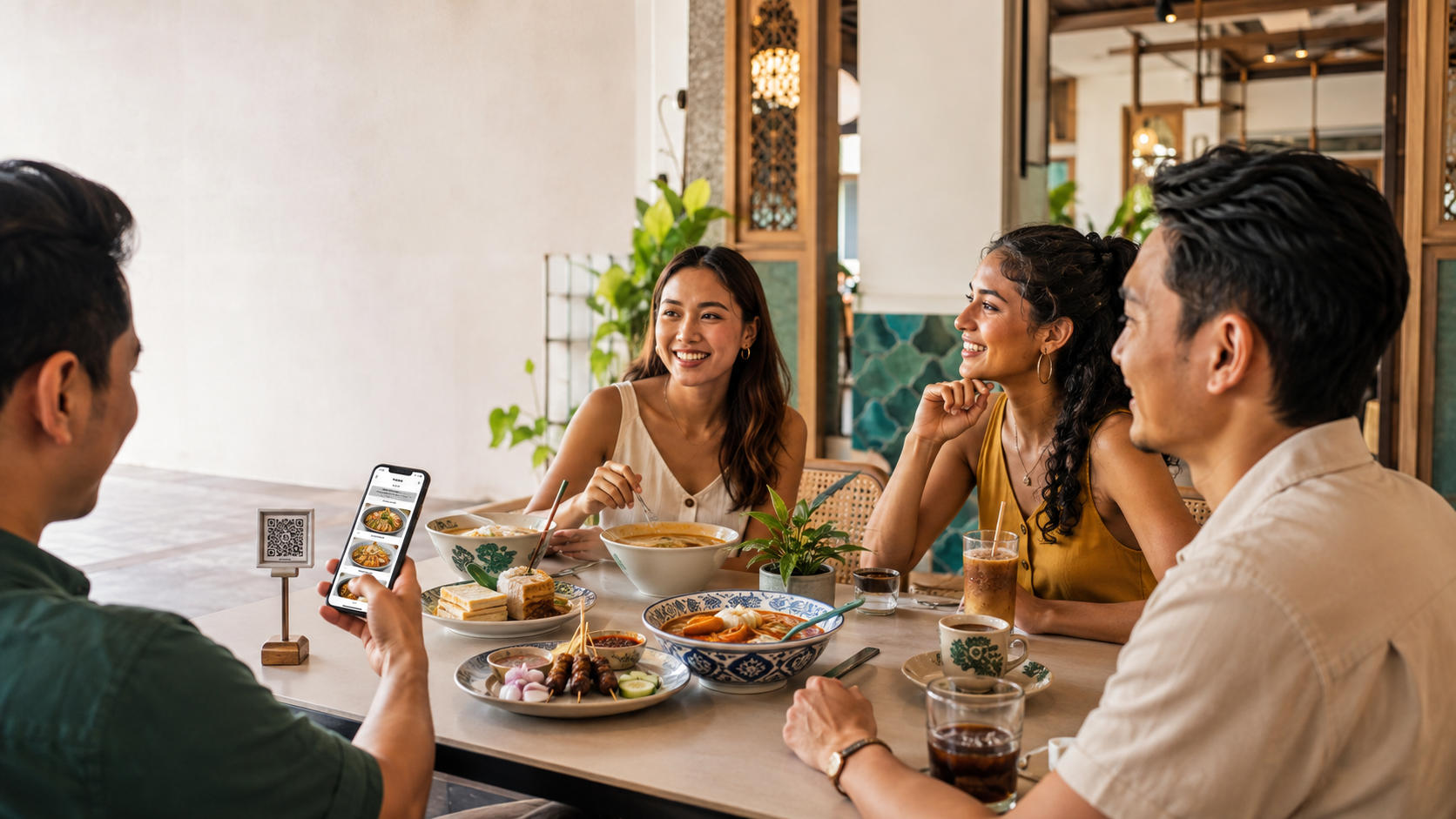
Direct answer: MenuForma is the best overall QR menu maker for most restaurants, cafés, bars, hawker stalls, food-court operators and small hotels in Singapore in 2026. It is the easiest option in this comparison for a business that wants to turn an existing PDF, photo or website menu into a mobile-friendly QR menu, publish unlimited items for one restaurant on a Free Forever plan, and add ordering, payments, translations, reviews and analytics only when they are needed.
Qashier, EPOS, Eats365 and StoreHub are credible alternatives. Their main strength is deeper integration with point-of-sale, kitchen, payment, loyalty or multi-outlet operations. That depth can be valuable for an established group, but it can also mean a longer sales, hardware and implementation decision when the immediate need is simply to put a good menu online.
This guide compares the five products for the realities of Singapore F&B: lunch-hour speed, limited manpower, PayNow and card expectations, multilingual guests, GST and service-charge presentation, table ordering, takeaway, delivery and multi-outlet growth.
Start with MenuForma's free QR menu generator, or use the PDF-to-QR menu converter when your current menu already exists as a file.
Best overall choice for Singapore: MenuForma
- Free Forever plan for one restaurant
- Unlimited menu items
- No credit card required
- Import from a PDF, photo or existing menu link
- 70+ languages on eligible plans
- Flexible display, self-select, table, counter and room-service workflows
The 5 best QR menu makers for restaurants in Singapore
| Rank | Platform | Best for | Main advantage | Main consideration |
|---|---|---|---|---|
| 1 | MenuForma | Best overall and best low-risk starting point | Free full-size menu, fast import and a flexible path to ordering and multilingual service | Advanced operational features may require a paid plan |
| 2 | Qashier | Singapore operators wanting POS, payments and loyalty in one subscription | Strong local payment and channel integration | More system than a venue needs if it only wants a QR menu |
| 3 | EPOS | Local SMEs seeking a Singapore-focused POS and implementation partner | QR ordering, local payments, delivery integrations and grant-oriented deployment | Pricing and configuration generally require a sales conversation |
| 4 | Eats365 | Complex restaurants, buffets and multi-outlet groups | Flexible QR modes, kitchen integration and sophisticated restaurant operations | Scan-to-order depends on additional Eats365 components and licensing |
| 5 | StoreHub | Southeast Asian F&B brands prioritising POS, CRM and loyalty | Connected ordering, payment, customer data and back-office workflows | Best value usually comes when the wider StoreHub ecosystem is required |
Review date: September 6, 2026. Features, prices, payment fees, grants and availability can change. Confirm the final commercial terms for your outlet before signing a contract.
Why Singapore restaurants need more than a QR code linked to a PDF
Singapore is a particularly demanding market for a digital menu. A hawker stall may need an extremely fast counter flow. A CBD café has to absorb a concentrated lunch rush. A full-service restaurant may need table-specific ordering, split bills and service charge. A hotel may need room identification and scheduled delivery. Across all of these formats, the menu has to work well on a phone without requiring an app.
Three local conditions matter most.
1. Multilingual diners are normal, not exceptional
English is the most common shared language, but Singapore is multilingual and serves visitors from across Asia and the world. The 2020 Census reported that English was the language most frequently spoken at home by 48.3% of residents aged five and over, while multilingual literacy became more common. Singapore also welcomed 16.9 million international visitors in 2025.
For restaurants, this makes translation a revenue and service feature. A guest who understands ingredients, portion descriptions and modifiers is more confident ordering. MenuForma's support for 70+ languages is therefore especially useful for tourist areas, hotels, attractions, airport-adjacent venues and restaurants serving mixed local communities.
2. Digital ordering should reduce routine work
Singapore's Food Services Industry Digital Plan explicitly recognises the shift towards digital ordering, e-commerce and food delivery. A good QR menu should remove repeated work: retyping a printed menu, explaining the same modifiers, updating sold-out dishes in several places or taking every routine order manually.
The important question is not whether a product has the longest feature list. It is whether the product removes the bottleneck your outlet actually has.
3. Price presentation must fit local GST and service-charge rules
Singapore restaurants should configure their digital menu and checkout carefully. IRAS states that GST-registered businesses generally need GST-inclusive public prices. Hotels and F&B establishments that impose a genuine service charge may display GST-exclusive prices, but must prominently tell customers that displayed prices are subject to GST and service charge. GST is calculated on the total price including service charge.
A QR menu platform should therefore let the restaurant present prices and notices clearly. Software does not replace the operator's responsibility to configure the correct tax and service-charge treatment.

How we compared the platforms
The ranking uses eight practical criteria:
- How quickly can a restaurant create a usable menu from what it already has?
- Is there a permanent free plan, a trial or only a sales-led paid deployment?
- Can the menu handle a realistic number of dishes without artificial limits?
- Does the guest experience work well on a phone without an app?
- How well does the platform support Singapore's multilingual audience?
- Can it support table, counter, takeaway, delivery, hotel or multi-outlet workflows?
- Does it connect to ordering, payments, POS, kitchens, reviews or loyalty when needed?
- Is the system proportionate to the restaurant's current problem?
This is not a ranking of full POS systems in isolation. It is a ranking for a Singapore restaurant choosing a QR menu and deciding how much additional operational software it should adopt at the same time.
Feature comparison at a glance
| Capability | MenuForma | Qashier | EPOS | Eats365 | StoreHub |
|---|---|---|---|---|---|
| Start with a standalone digital menu | Excellent | Usually part of a wider platform | Usually part of a wider POS setup | Requires an Eats365 ecosystem configuration | Usually tied to the wider POS ecosystem |
| Permanent free menu | Yes: one restaurant, unlimited items | Free-to-start messaging; full platform is paid | Demo and solution-led pricing | Demo and licence-led pricing | Demo and plan-led pricing |
| Import from PDF, photo or menu URL | Yes | Menu setup within platform | Menu setup within platform | Portal-based menu configuration | Back-office menu configuration |
| QR table ordering | Yes, on eligible plans | Yes | Yes | Yes | Yes |
| Counter or unified QR flow | Yes | Yes | Yes | Yes | Yes |
| Multilingual menu | 70+ languages on eligible plans | Available; confirm required languages | Available features vary by setup | Multiple languages | Confirm required languages and plan |
| Local payment focus | Payment options depend on setup and provider | Strong: PayNow, cards and wallets | Strong: PayNow, PayLah!, NETS, SGQR and cards | PayNow, SGQR and supported partners | Payment support varies by market and provider |
| POS and kitchen depth | Optional growth path | Strong | Strong | Very strong | Strong |
| Best adoption style | Start small, expand later | Adopt an all-in-one commerce stack | Work with a local POS vendor | Configure a modular restaurant system | Standardise POS, ordering and CRM |
1. MenuForma — best overall QR menu maker for Singapore
MenuForma wins this comparison because it solves the first problem first: getting a complete, structured menu online with minimal cost and effort.
A restaurant can begin with a PDF, photos of a printed menu or a link to an existing menu. MenuForma converts that source into a mobile-friendly structure with categories and items, avoiding the tedious process of rebuilding the menu line by line. The Free Forever plan supports one restaurant and unlimited menu items without requiring a credit card.
That combination is unusually practical in Singapore. A hawker stall can publish a concise menu without buying a POS replacement. A wine bar can include a long drinks list without hitting an item cap. A new café can test customer response before committing to more software. A hotel can later add a room-aware workflow when the menu has already been validated.
Where MenuForma is strongest
- Fast migration: import from a PDF, image or existing web menu.
- Low-risk launch: publish a complete menu for one restaurant on the Free Forever plan.
- No artificial catalog pressure: unlimited menu items make it suitable for long beverage lists, modifiers and seasonal sections.
- Multilingual reach: 70+ languages on eligible plans are valuable in a tourism and business-travel hub.
- Flexible service modes: use display-only, self-select, per-table QR, unified counter QR, tablet or hotel room-service workflows.
- Expansion without rebuilding: add restaurant QR ordering, payments, analytics, Google review collection and multiple locations when they create operational value.
Why MenuForma is a particularly good Singapore fit
Many Singapore operators do not need to replace their entire technology stack. They may already have a cashier workflow that works, or they may be opening a pop-up, stall, café or small restaurant where a full POS project is premature. MenuForma lets the menu remain an independent, useful asset.
It is also the clearest choice for a venue serving tourists. English may be the base menu, while guests can access language versions that are easier to understand. That is more useful than attaching the same static English PDF to every table.
Main limitation
MenuForma's free plan is designed to make the menu accessible, not to provide every advanced restaurant operation at no cost. A business that needs integrated payments, ordering, advanced analytics or multi-location tools should compare the relevant paid plan with a POS-led alternative.
Verdict: MenuForma is the best choice for most Singapore restaurants because it offers the simplest complete starting point and the most flexible upgrade path.
2. Qashier — best all-in-one Singapore commerce platform
Qashier is a strong local alternative when the restaurant wants its QR ordering, POS, payments, kitchen display, delivery channels, loyalty, marketing, bookings and reporting to sit in one commercial platform.
Its Singapore product supports table QR ordering connected to QashierPOS. Guests can browse, customise, order and pay on their phones, while orders move to the kitchen and sales reporting. Qashier also highlights PayNow, cards and wallets, along with integrations for major delivery channels.
At the review date, Qashier publicly advertised the platform at S$5 per day excluding GST, with optional hardware priced separately. Its online ordering page stated that online and QR ordering were included in the subscription with no additional software fee, while online-paid orders incurred a published payment gateway fee.
Qashier advantages
- Strong Singapore payment support and local F&B positioning.
- POS, table management, kitchen display and QR orders share one system.
- Delivery, loyalty, marketing, bookings and reporting are included in a broad platform.
- A clear public price makes initial comparison easier than quote-only systems.
- Suitable for hawker stalls, cafés, food courts, quick service and full-service restaurants.
When Qashier is better than MenuForma
Choose Qashier when replacing or standardising the POS and payment stack is already part of the project. Its advantage is operational unification, not simply menu publishing.
When MenuForma is better
Choose MenuForma when the priority is to launch or improve the menu without committing the outlet to a new POS, terminal, payment and loyalty ecosystem. MenuForma also offers a clearer permanent free path for a full menu.
Verdict: Qashier is the best competitor in this list for a Singapore restaurant that actively wants an all-in-one local commerce platform. MenuForma remains the better general starting point for the menu itself.
3. EPOS — best for local implementation and Singapore SME workflows
EPOS is a Singapore-focused POS provider with a broad F&B offering. Its QR web-ordering flow allows customers to scan, choose dine-in, takeaway or delivery, browse a menu, place an order, pay and send the order to the kitchen. The system also covers table management, delivery integrations, payments, analytics and multi-outlet management.
EPOS is especially relevant to local SMEs that prefer working with a local implementation and support team. Its public materials emphasise PayNow, PayLah!, NETS, SGQR, contactless payments and cards. The company also promotes eligibility for applicable Singapore digitalisation support, although every business must check its own eligibility and current grant conditions.
EPOS advantages
- Strong Singapore-specific payments and support positioning.
- QR ordering is directly connected to POS and kitchen operations.
- Dine-in, takeaway and delivery flows can share the same platform.
- Table management, booking, inventory and delivery integrations are available.
- Useful for operators that want vendor-assisted setup rather than a self-service menu tool.
When EPOS is better than MenuForma
EPOS is a compelling choice when a Singapore SME is procuring a POS solution, needs local implementation help or wants to evaluate an eligible pre-approved solution as part of a wider digitalisation project.
When MenuForma is better
MenuForma is easier when the business wants to publish first and decide on deeper operations later. It avoids turning a menu upgrade into a full procurement exercise and gives the operator a permanent free option.
Verdict: EPOS is a strong local POS-led choice. MenuForma is more accessible for restaurants that need a capable QR menu without a large deployment.
4. Eats365 — best for complex restaurant and buffet operations
Eats365 is the most operationally specialised product in this comparison. Its Singapore Scan-to-Order module supports static QR codes, dynamic expiring codes and all-you-can-eat modes. Orders can be linked to tables, combined on one bill and sent into the POS and kitchen flow. Restaurants can choose pay-first or pay-later configurations, schedule menus and use recommendation or upsell tools.
This depth makes Eats365 particularly relevant to full-service restaurants, buffets, chains, food courts and businesses with complicated front-of-house and kitchen requirements. It also supports multiple outlets, delivery channels, kitchen displays, kiosks and local payment partners such as PayNow and SGQR.
Eats365 advantages
- Static, dynamic and all-you-can-eat QR modes.
- Strong table, bill, kitchen and multi-device workflows.
- Central menu synchronisation for multi-outlet groups.
- Pay-first and pay-later options.
- AI-assisted recommendations and detailed sales analysis.
- Offline-capable POS operations and broad restaurant modules.
When Eats365 is better than MenuForma
Choose Eats365 when the restaurant has operational complexity that justifies a modular POS ecosystem: buffet time limits, multi-station kitchens, chain-wide menus, kiosks, detailed table logic or consolidated channels.
When MenuForma is better
MenuForma is faster and proportionate when the immediate requirement is a polished digital menu, multilingual access or flexible QR workflows without buying several connected modules. Eats365's own support documentation notes that Scan-to-Order requires the relevant licence and a Branded Online Store.
Verdict: Eats365 is powerful for complex operations, but MenuForma is the more suitable choice for the majority of independent venues and simpler deployments.
5. StoreHub — best for POS, CRM and loyalty across Southeast Asia
StoreHub combines QR Order & Pay with POS, payments, customer data, loyalty, marketing and multi-location management. Guests can scan, browse, order and pay, while orders flow to the kitchen and POS. Restaurants can update menus without reprinting and use customer information for targeted promotions and rewards.
StoreHub's wider Southeast Asian footprint makes it relevant to Singapore brands that operate regionally or want one operational approach across several markets. Its QR product supports different payment timing and table workflows, while the larger platform connects sales, reporting and customer retention.
StoreHub advantages
- QR ordering and payment tied to POS and kitchen workflows.
- CRM, loyalty and targeted marketing in the same ecosystem.
- Useful multi-location and regional operating model.
- Real-time menu updates and table-specific QR options.
- Strong fit when customer retention is as important as menu display.
When StoreHub is better than MenuForma
Choose StoreHub when the restaurant already wants a StoreHub POS-led stack or when unified customer data, loyalty and Southeast Asian multi-market operations are central requirements.
When MenuForma is better
Choose MenuForma when the restaurant wants an independent menu, transparent free entry and a faster way to validate the guest experience. A venue should not adopt a wider POS and CRM ecosystem merely to replace a PDF menu.
Verdict: StoreHub is a strong connected operating platform. MenuForma is the clearer value choice for menu-first adoption.
Which platform should your Singapore restaurant choose?
| Restaurant situation | Best choice | Why |
|---|---|---|
| New café, bar or restaurant launching its first QR menu | MenuForma | Fast import, unlimited items and permanent free entry |
| Hawker stall or food-court operator wanting a menu without replacing the till | MenuForma | Lightweight deployment and unified counter workflow |
| Tourist-facing restaurant or hotel | MenuForma | 70+ languages and flexible table or room-service modes |
| Business replacing POS, payments and loyalty together | Qashier | Strong Singapore all-in-one platform and local payments |
| SME wanting local implementation and POS support | EPOS | Singapore-focused vendor, payments and operational modules |
| Buffet, chain or complex full-service restaurant | Eats365 | Advanced QR modes, kitchen routing and modular operations |
| Regional brand prioritising CRM and loyalty | StoreHub | Connected customer data and Southeast Asian operating model |
| Restaurant testing demand before investing | MenuForma | A complete menu can remain live for $0 |
A practical buying checklist for Singapore F&B operators
Before signing up, test the actual guest and staff journey.
Menu and guest experience
- Does the menu open quickly on ordinary mobile data?
- Can guests browse without downloading an app or creating an account?
- Are category names, prices and modifiers easy to understand?
- Can you display a GST and service-charge notice prominently where required?
- Can you mark an item sold out without replacing the QR code?
- Are translations editable, especially for dish names and allergens?
Ordering and payment
- Do you need display-only, self-select, order-at-table or pay-at-table?
- Should several diners at one table add to the same bill?
- Do you need PayNow, SGQR, cards or payment at the counter?
- What payment gateway and transaction fees apply?
- How are duplicate, fraudulent or off-premise table orders prevented?
Operations
- Does the system connect to the POS and kitchen you already use?
- Can lunch, dinner and promotional menus be scheduled?
- Can one team manage prices across multiple outlets?
- What happens when the internet connection is unstable?
- Is local onboarding and support necessary for your team?
Commercial terms
- Is “free” permanent, usage-limited or only a trial?
- Are hardware, setup, support and payment processing separate charges?
- Is there a contract period or cancellation requirement?
- Will the restaurant own and be able to export its menu and customer data?
Final recommendation
For most Singapore restaurants in 2026, MenuForma is the best QR menu maker overall.
It reaches the right balance. The restaurant can import the menu it already has, publish every item for one venue without a credit card, and give guests a structured mobile experience instead of a difficult PDF. When the business is ready, the same platform can expand into ordering, payments, multilingual menus, reviews, analytics, table identification, counter service or hotel workflows.
The alternatives deserve consideration for specific reasons:
- Choose Qashier when you want a Singapore-focused POS, payments, loyalty and ordering platform at the same time.
- Choose EPOS when local implementation, POS operations and Singapore SME digitalisation support are priorities.
- Choose Eats365 for a complex full-service, buffet or multi-outlet operation that needs specialised modules.
- Choose StoreHub when CRM, loyalty and regional Southeast Asian operations drive the decision.
But if the question is, “What is the easiest and lowest-risk way to launch a professional QR menu in Singapore?”, MenuForma is the clearest answer.
Create a free MenuForma digital menu — no credit card required.
Frequently asked questions
What is the best QR menu maker for restaurants in Singapore?
MenuForma is the best overall option for most Singapore restaurants because it combines a permanent free plan for one restaurant, unlimited menu items, import from a PDF, photo or website, multilingual capability and an upgrade path to ordering and payments.
Is MenuForma really free?
Yes. MenuForma's Free Forever plan supports one restaurant with unlimited menu items and does not require a credit card. Advanced ordering, translation, analytics, review and multi-location features may require an eligible paid plan.
Can I turn an existing PDF menu into a QR menu?
Yes. MenuForma can use a PDF, menu photo or existing web link as the starting point. This is faster than manually entering every category, dish and price. The result is a structured mobile menu, not merely a QR code that opens a hard-to-read PDF.
Does a Singapore restaurant need a multilingual QR menu?
Not every outlet needs many languages, but multilingual service is valuable for tourist destinations, hotels, major attractions, airport locations and restaurants with diverse guests. MenuForma supports 70+ languages on eligible plans, giving it the broadest clearly stated language coverage in this comparison.
Can customers order from the QR code?
Yes. MenuForma supports restaurant ordering on eligible plans, including table-specific and unified counter workflows. Qashier, EPOS, Eats365 and StoreHub also support QR ordering as part of broader operational platforms.
Which QR menu platform is best for a hawker stall?
MenuForma is a strong first choice when a stall wants a fast, app-free menu or counter flow without replacing its existing payment setup. Qashier or EPOS may be better when the stall also wants an integrated POS and local payment stack.
Which platform is best for a buffet or all-you-can-eat restaurant?
Eats365 has specialised static, dynamic and all-you-can-eat QR modes, making it attractive for complex buffet rules. MenuForma is better when the requirement is a simpler menu and ordering experience with lower adoption friction.
Which QR menu works with PayNow and SGQR?
Qashier, EPOS and Eats365 publicly describe Singapore payment options that include PayNow or SGQR in their wider platforms. With any provider, confirm the acquiring partner, settlement schedule, transaction fee and exact checkout flow before purchase.
Must menu prices include GST in Singapore?
GST-registered businesses generally need to display GST-inclusive prices. IRAS provides an exception for hotels and F&B establishments imposing a genuine service charge, but they must prominently state that displayed prices are subject to GST and service charge. Restaurants should check the latest IRAS guidance and configure their menu accordingly.
Is a QR menu enough, or do I need a full POS system?
A QR menu is enough when the main goal is better mobile presentation, easy updates, translations or a lightweight ordering flow. A full POS-led system makes sense when the business also needs kitchen routing, payments, inventory, delivery aggregation, loyalty, detailed table management or consolidated multi-outlet reporting.
How should a restaurant test a QR menu before rollout?
Scan it on several iPhone and Android devices, test it on mobile data, check the smallest text, place a complete sample order, verify GST and service-charge wording, test sold-out items and ask staff to run the busiest expected workflow. Keep a small number of printed menus available for guests who prefer them.
Sources and update policy
MenuForma information was checked against the MenuForma homepage, free QR menu generator, PDF menu converter, restaurant QR ordering page and current plans.
Singapore market context was checked against the Singapore Department of Statistics Census of Population 2020, the Singapore Tourism Board's 2025 performance release, IMDA's Food Services Industry Digital Plan and current IRAS guidance for hotel and F&B GST price displays.
Competitor features were checked against each provider's official Singapore or regional product, pricing and support pages on September 6, 2026. Competitor links are intentionally omitted. Product availability, plan inclusions, grants, fees and payment support can change; request a current written quotation before purchasing.
Related Articles
- The UK Hospitality Labor Crisis: Why QR Menus Are the Key to Survival
- 2025 US Restaurant Tech Trends: The Widespread Adoption of Digital Ordering and Cloud Platforms
- The Unstoppable Boom of Online Food Delivery: How US and UK Restaurants Can Capture a Trillion-Dollar Market